

Start with a question. Build the canvas. Watch meaning emerge.
Your notes. Your thinking. Your actions.
All connected — all the way back.
See It In Action
Your canvas for deeper thinking
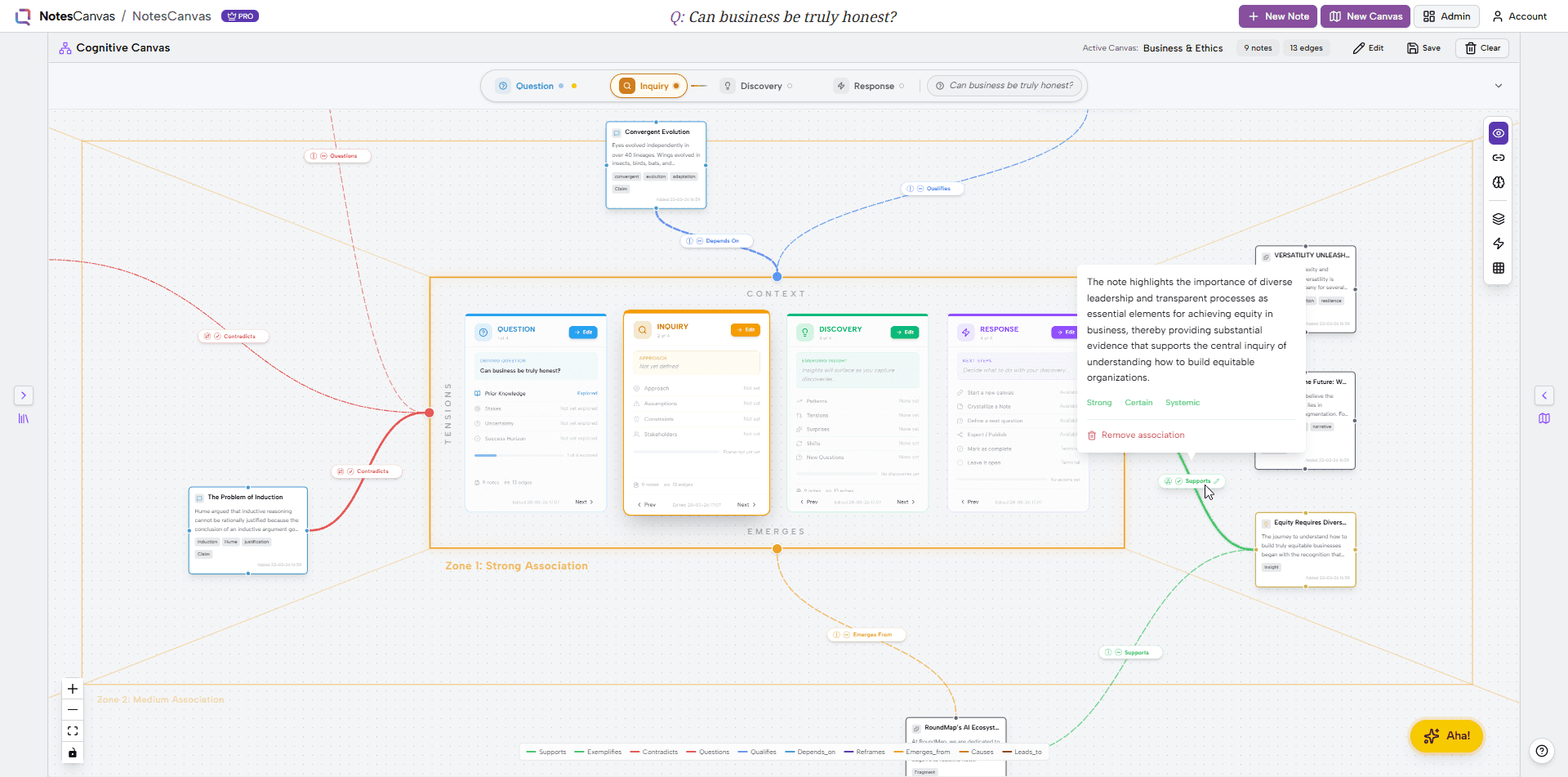
Connect notes to a central question. Watch relationships emerge. Let understanding unfold naturally across Question, Inquiry, Discovery, and Response.
Four Orientations
Move fluidly between Question, Inquiry, Discovery, and Response
Visual Connections
See how ideas support, contradict, or build upon each other
Association Zones
Understand relationship strength at a glance
The Problem
You capture everything.
You understand too little.
Most tools help you store what you know.
They let you capture, categorize, and retrieve — but they stop short of the harder thing: helping you make sense of it.
NotesCanvas is built for that harder thing.
It brings together questioning, inquiring, and sense-making into a single living process — where connections form across themes, domains, and disciplines, and meaning has room to emerge.
And when it does, that meaning doesn't float free. Whatever understanding arrives — whether it leads to a deeper question, a new direction, a conversation worth having, or an action worth taking — the trace of how you got there stays intact.
Because insight without its origins is just a feeling.
NotesCanvas keeps the thread.
A Method for Thought
Structure without constraint
Just as the scientific method gives researchers a reliable framework to investigate any question, NotesCanvas offers a methodology for thought — four orientations that guide your inquiry without dictating its direction.
You choose the question. The method helps you find the answer.
Four Orientations
Understanding has no fixed path
Question, Inquiry, Discovery, Response — four orientations you move between as thinking demands. The trace holds them together, so wherever you are, you can always see where understanding came from.
The thread running through all four is the epistemological trace — the visible chain that anchors action to discovery, discovery to inquiry, inquiry to the original question.
Question
Begin with a question worth exploring. Frame what puzzles you, what you want to understand, or what decision you need to make.
Inquiry
Gather notes onto a spatial canvas. Draw associations -- support, contrast, reframe. AI surfaces material you may have missed.
Discovery
Patterns surface. Record your insight, or let AI synthesize an augmented perspective from the connections you have drawn.
Response
Define what this thinking leads you to do. Your response becomes the driving question of a new canvas -- carrying inquiry forward.
"We are drowning in information, while starving for wisdom. The world henceforth will be run by synthesizers, people able to put together the right information at the right time, think critically about it, and make important choices wisely."-- E.O. Wilson, Harvard biologist and philosopher of knowledge
From The Blog
Method to the Thinking
Exploring why methodological thinking matters in an age of information overload and AI assistance.

They Aren’t Arguing With You
On predictive processing, the consolation of misreading, and what a reader’s objection actually tells you
Can You Trust an App With Your Thinking?
You’ve spent years building a mind you can rely on. The idea of handing any part of that to a tool feels like a betrayal. This post is for everyone who has felt that instinct — and wondered whether it was wisdom or just habit.

The Fourth Room: From Thinking Hard to Thinking Well
Most tools help you capture what you know. Fewer help you make sense of it. None help you find your way back to how you got there. This post is for the people who have spent years thinking hard about something that matters — and know exactly what it costs when the structure isn’t there.
FAQ
Frequently Asked Questions
Everything you need to know about NotesCanvas.
There is one objection to NotesCanvas that I respect more than any other. Not “is it easy to use?” or “does it sync across devices?” — but something deeper and more personal:
I’ve come to trust my own mind. My memory, my capacity to hold complexity, my ability to find my way through hard problems. Why would I hand that to an app?
This is not technophobia. It is not laziness in reverse. It is loyalty — to the instrument you have spent years developing, testing, and learning to rely on. For serious thinkers, the mind is not just a tool. It is the thing itself. Questioning it feels like self-betrayal.
And yet.
If you are honest with yourself, you may also recognise something else: that at a certain point, as the knowledge built up and the problems grew larger, progress slowed. Not because you became less capable — but because more and more of your cognitive capacity was being consumed by the scaffolding. By the work of holding the structure together so the thinking could happen at all. The mind that once moved freely through a problem was increasingly occupied with maintenance.
That slowdown is not a sign of diminishing ability. It is a sign that you were asking your memory to do something it was never designed to do.
Your mind,
made visible.
Give your ideas room to connect.
Watch the picture emerge.