The NotesCanvas Blog
Method to the Thinking
Exploring why methodological thinking matters for personal clarity, societal discourse, and the age of AI.

From Hoarding Notes to Healing Understanding
Storing notes collects the parts. Associating them around a Guiding Question helps us restore a fragmented understanding of the whole.

The Answer AI Gives You Is Never Truly Yours
AI can rapidly synthesize plausible answers from existing information, but those answers remain the product of the AI’s reasoning - not the user’s. This may suffice for simple questions, but complex matters require us to examine evidence, confront tensions, consider different perspectives, and recognize possibilities that no individual source already contains. NotesCanvas places the user inside this process: guided by a meaningful question, they bring their own notes and experiences into relationship, assess AI-suggested associations, and discover what emerges. Instead of outsourcing the cognitive effort through which understanding develops, the user actively trains it—and constructs an answer they genuinely understand, can defend, and call their own.
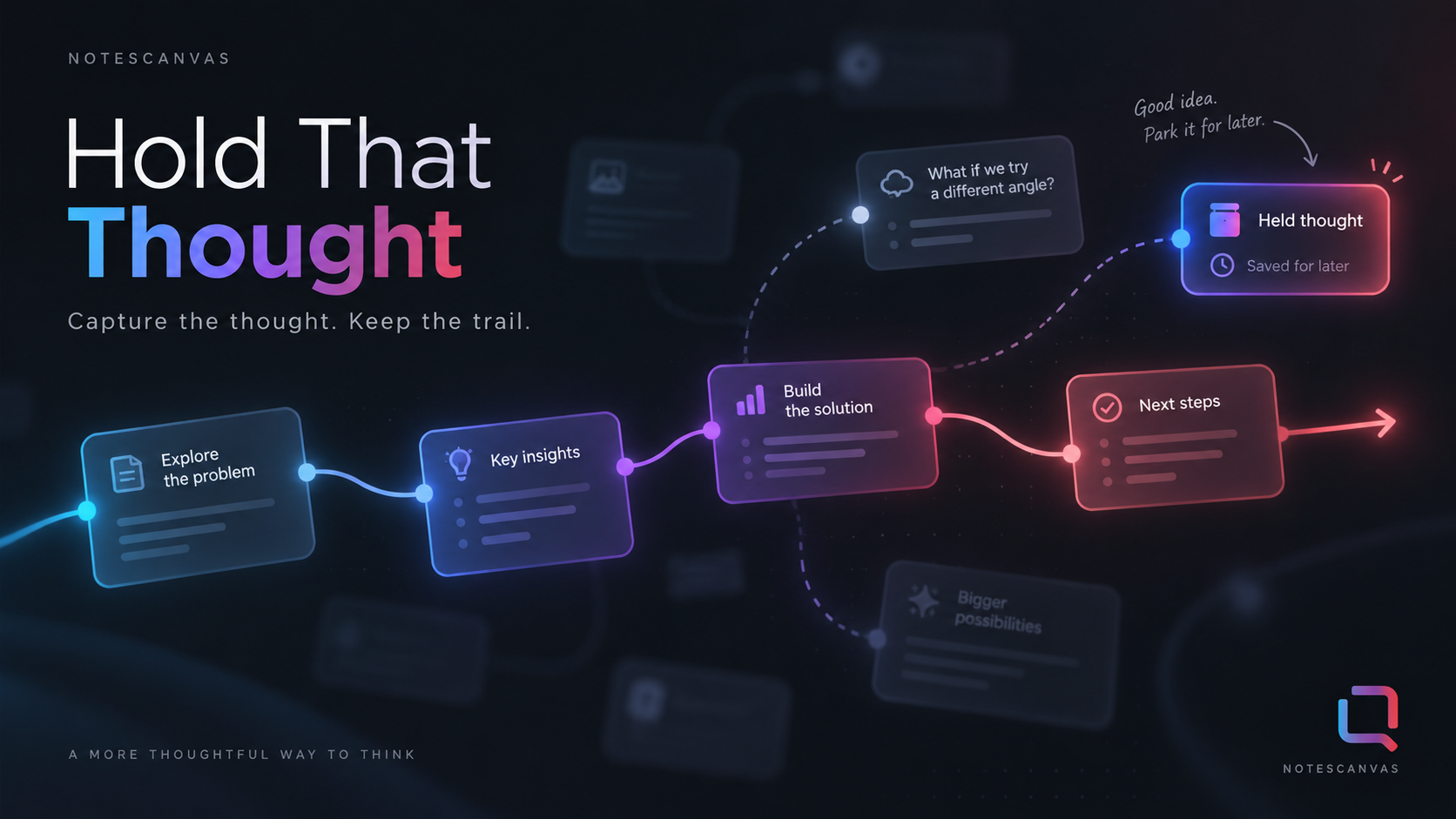
Hold That Thought: Protecting the Trail You’re Already On
You have a canvas open. Notes are appearing, moving, connecting. You are considering different perspectives, testing assumptions, following relationships, perhaps slowly beginning to see the contours of something that was not obvious when you started. And then another thought appears. Follow it, and you may discover something valuable, but you may also lose the trail you were already on. With Hold!, NotesCanvas lets you capture that emerging thought without having to follow it.
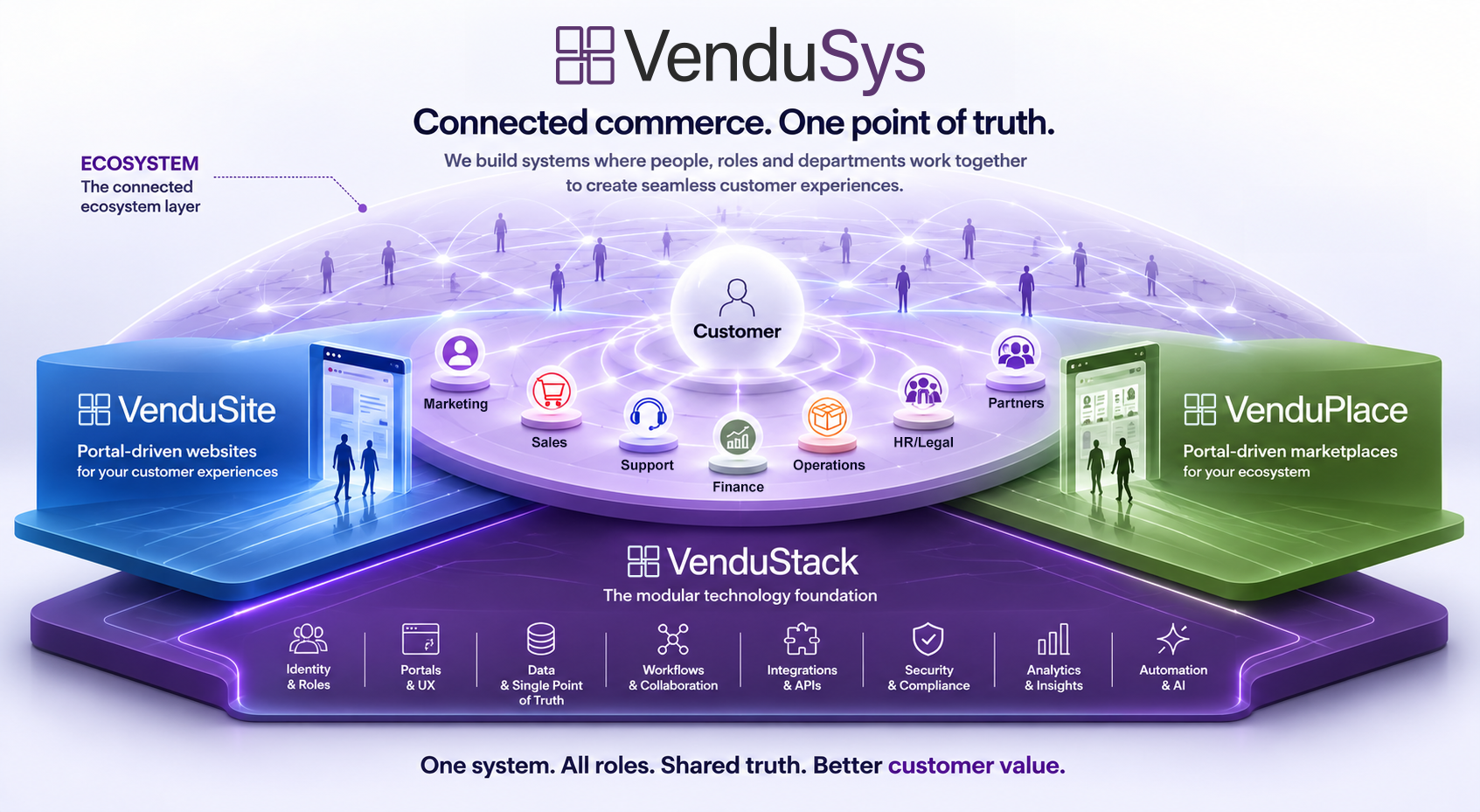
How Thinking Slow Led to Building a Value Orchestration Infrastructure
For years, I was trying to understand why so many organizations, despite their best intentions, struggle to create lasting value. That journey led me to question some of the most fundamental assumptions in business: that commerce is primarily about transactions rather than relationships, that organizational silos improve performance, that financial success is the ultimate measure of value, and that technology should optimize existing processes instead of transforming them. This article tells the story of how that slow process of inquiry gave rise to RoundMap®, and ultimately to VenduSys: a Value Orchestration Infrastructure designed to help businesses regenerate the ecosystems they depend on by making relationships, learning, and collective value creation central to how they operate.

The Thinking Was Never the Problem
Most of us were never taught what comes after understanding. That gap is costing us more than we realize.
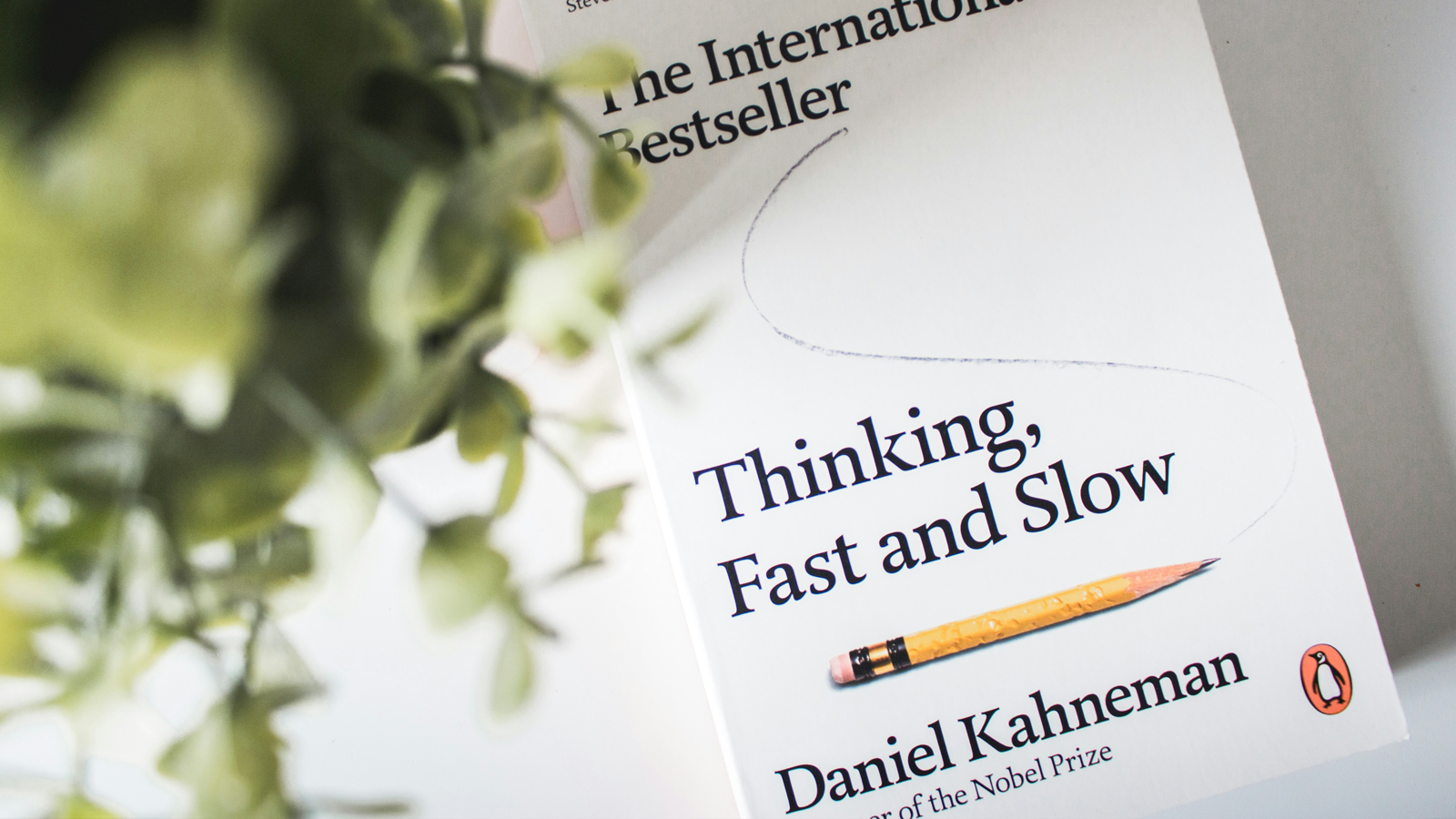
Two Ways of Knowing — And Why the Faster One Deceives You
What Kahneman's masterwork tells us about AI, shortcuts, and what it actually means to think.

Writers Don’t Fail at Writing - They Fail Before It
Most writers don’t struggle with writing itself, but with the unstructured thinking that comes before it. Without a system to explore ideas, test assumptions, and connect insights, notes remain fragmented and direction unclear. NotesCanvas provides a structured thinking framework that guides writers from question to conclusion—so when writing begins, it becomes the articulation of a well-formed argument, not the search for one.
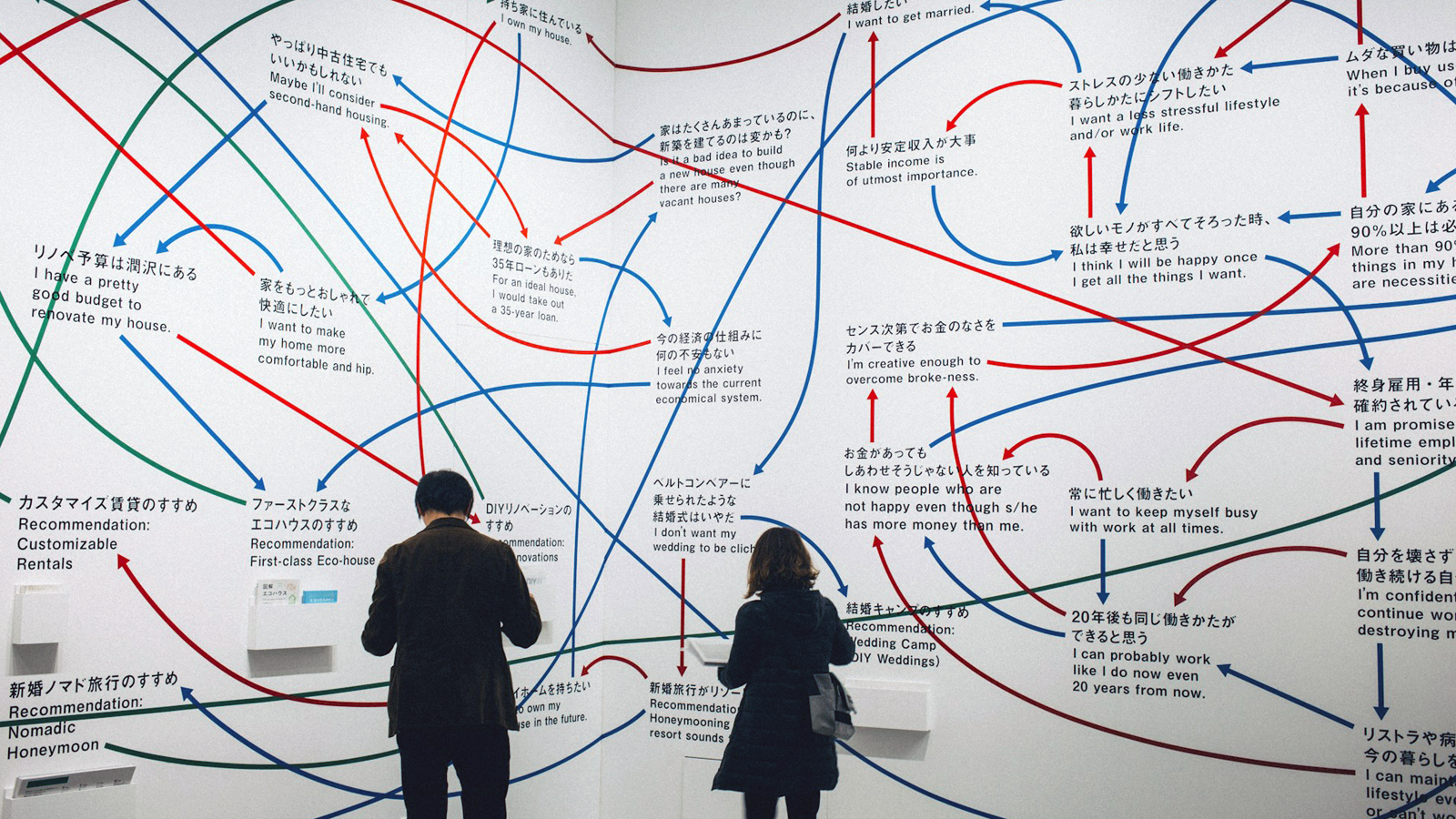
The Canvas Trap: From Organizing Notes to Generating Insight
Mind mapping and blank canvases excel at organizing information—but organization is not thinking. They help structure what you already know, yet stop short of generating insight. In complex domains, where premature conclusions obscure more than they reveal, this becomes a limitation: without a guiding method, a canvas reflects your current understanding rather than helping you move beyond it.

They Aren’t Arguing With You
On predictive processing, the consolation of misreading, and what a reader’s objection actually tells you
Can You Trust an App With Your Thinking?
You’ve spent years building a mind you can rely on. The idea of handing any part of that to a tool feels like a betrayal. This post is for everyone who has felt that instinct — and wondered whether it was wisdom or just habit.

The Fourth Room: From Thinking Hard to Thinking Well
Most tools help you capture what you know. Fewer help you make sense of it. None help you find your way back to how you got there. This post is for the people who have spent years thinking hard about something that matters — and know exactly what it costs when the structure isn’t there.
NotesCanvas Is Not a Sticky-Note App. It’s a Thinking Model Canvas.
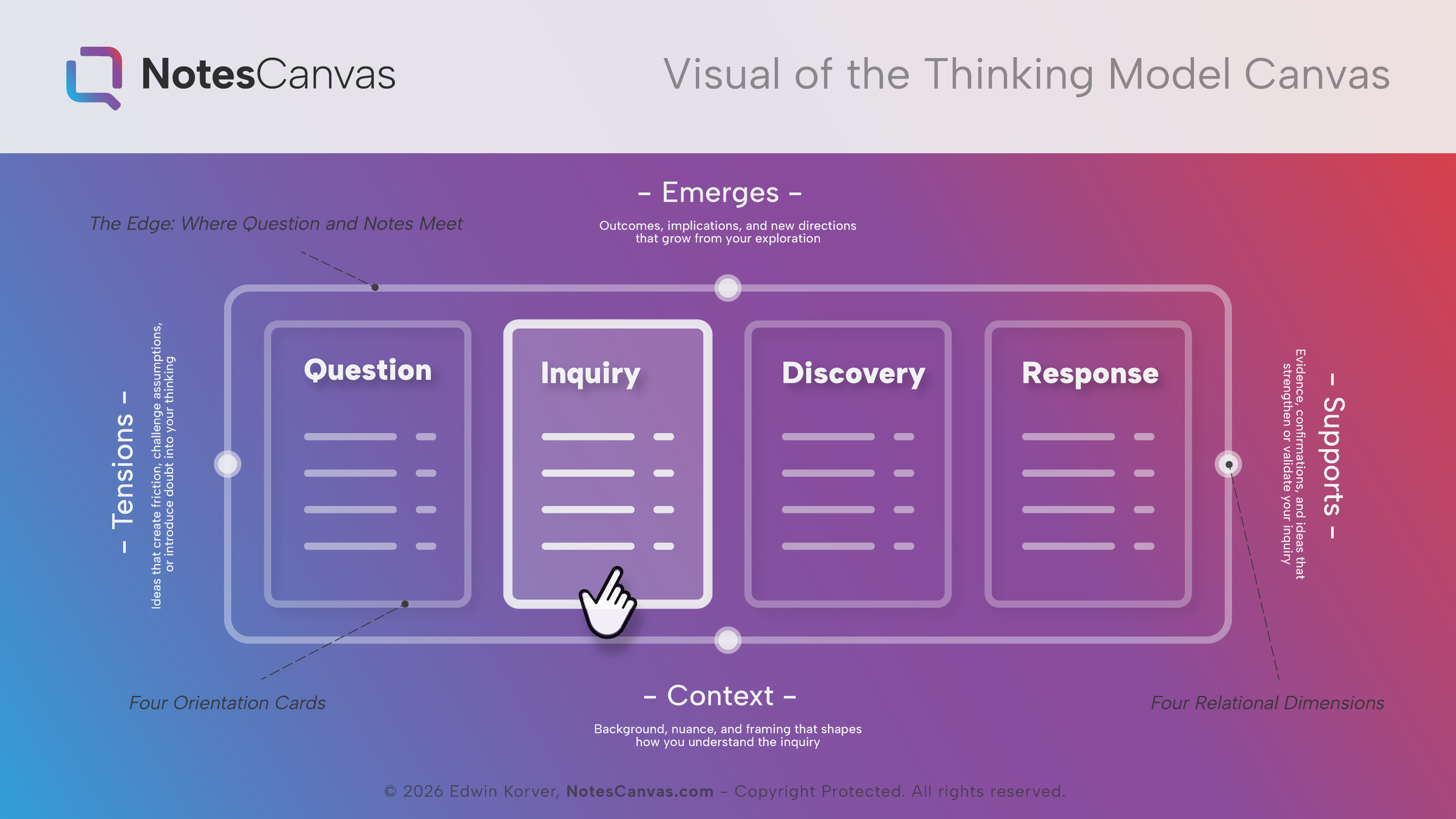
NotesCanvas is built around the idea that thinking has structure — and that structure can be made visible. Unlike typical note-taking tools that treat thinking as a storage problem, it offers a Thinking Model Canvas: a framework that guides you through four stages (Question, Inquiry, Discovery, Response) while organizing your notes across four relational dimensions (Tensions, Context, Supports, Emerges). AI assistance is available but deliberately subordinate to your own judgment. The result is a tool designed for anyone who regularly wrestles with genuinely hard questions — turning messy, unresolved thinking into something consequential.

Everything Clicked. Then We Changed the Name.
There's a moment in every product's life when the name stops fitting — not because it failed, but because it grew. NotesCanvas arrived from a simple question: what does this tool actually do? The answer was right there. But the name quietly runs deeper: notes capture what is observed, the canvas provides the space to place, move, and connect — and from that process of arranging and returning and reframing, truth emerges. Not engineered. Found. That's usually the sign of the right name.

The Shower Thought Is Not the Insight: it's an Invitation
Eureka moments, those fleeting flashes of clarity that arrive in the shower or on a walk, are not insights. They are invitations to one. The real work begins when you place that spark onto a canvas and start asking hard questions: What supports it? What contradicts it? What emerges from it? NotesCanvas is built for exactly this process; not to capture notes, but to help you interrogate them. It is a thinking environment, not a filing system. One designed to follow the spark all the way to whatever truth it contains.

Why You Forget About Most of the Books You Read
Most people retain little from the books they read because the brain isn't a storage device — it's a prediction engine that only consolidates information when it's resolving an active question. Without a genuine knowledge gap, encoding stays shallow and forgetting is rapid. The fix is simple but deliberate: before opening a book, formulate a real, unsettled question it might answer. That question orients the brain, sharpens attention, and triggers durable memory when the answer arrives. You don't remember books that informed you — you remember the ones that found you mid-question.

Mental Silos: The Lens You Don’t Know You’re Wearing
Organizational silos are commonly treated as structural problems, but this post argues their true origin is psychological: the moment a person conflates what they do with who they are. When professional roles become core identities, they shape perception itself — each specialist sees reality through an invisible lens formed by their title. In groups, these sealed worldviews prevent genuine collaboration and erode shared responsibility. Drawing on Descartes, the post invites readers to hold their roles more lightly — as tools rather than as identity — suggesting this personal shift is the real precondition for organizational wholeness.
You Are Living in a Mental Silo. You Just Can’t See the Walls.
The story of Silo mirrors how people can become trapped in self-reinforcing belief systems. Organizational silos are only symptoms; the deeper issue is the mental silo, the assumptions and frames we rarely question. Modern AI often reinforces this by providing fast, fluent answers that favor intuitive thinking over deeper reasoning, creating the illusion of understanding without genuine insight. Escaping this trap requires deliberate, slow thinking and personal inquiry. Tools like NotesCanvas aim to support that process by encouraging exploration, friction, and connection, helping people think for themselves rather than outsourcing their thinking.

You Can Only Connect the Dots Looking Backward. But the Dots Determine What You’ll See Next.
Steve Jobs claimed we can only connect the dots looking backward, but neuroscience suggests otherwise. The brain continuously generates predictions based on prior knowledge, meaning the "dots" we accumulate don't just connect in retrospect — they actively shape what we can perceive going forward. Polymaths outperform specialists not because they know more, but because their diverse mental models detect patterns others miss. Deliberately building richer, more connected knowledge isn't passive — it's constructing a sharper instrument for seeing the world.

Your Brain Doesn’t Learn by Working Alone: Neither Should Your Tools
For decades, neuroscience assumed that learning made the brain more efficient by reducing redundancy — but a new study in Science overturns this entirely. As subjects learned visual discrimination tasks, neurons became more coordinated, not less, and this coordination only emerged under active, goal-oriented engagement, never passive observation. The implication is profound: understanding doesn't accumulate through exposure to information; it crystallizes when prior knowledge and present inquiry are brought into active relation. For anyone designing thinking tools, an archive alone isn't enough — genuine insight requires structure, engagement, and the right conditions for coordinated inference to take hold.

Reclaiming the Mind: A Practice for Thinking in the Age of Instant Answers | Part 3/3
Five practices to reclaim thinking: write your own response before prompting; preserve your reasoning trail; let important questions age; read widely and slowly; connect ideas before concluding. AI should stress-test your thinking, never replace it. The goal is staying the thinker — not becoming a curator of borrowed conclusions.
The Art of Thinking: What Actually Happens When We Think | Part 2/3
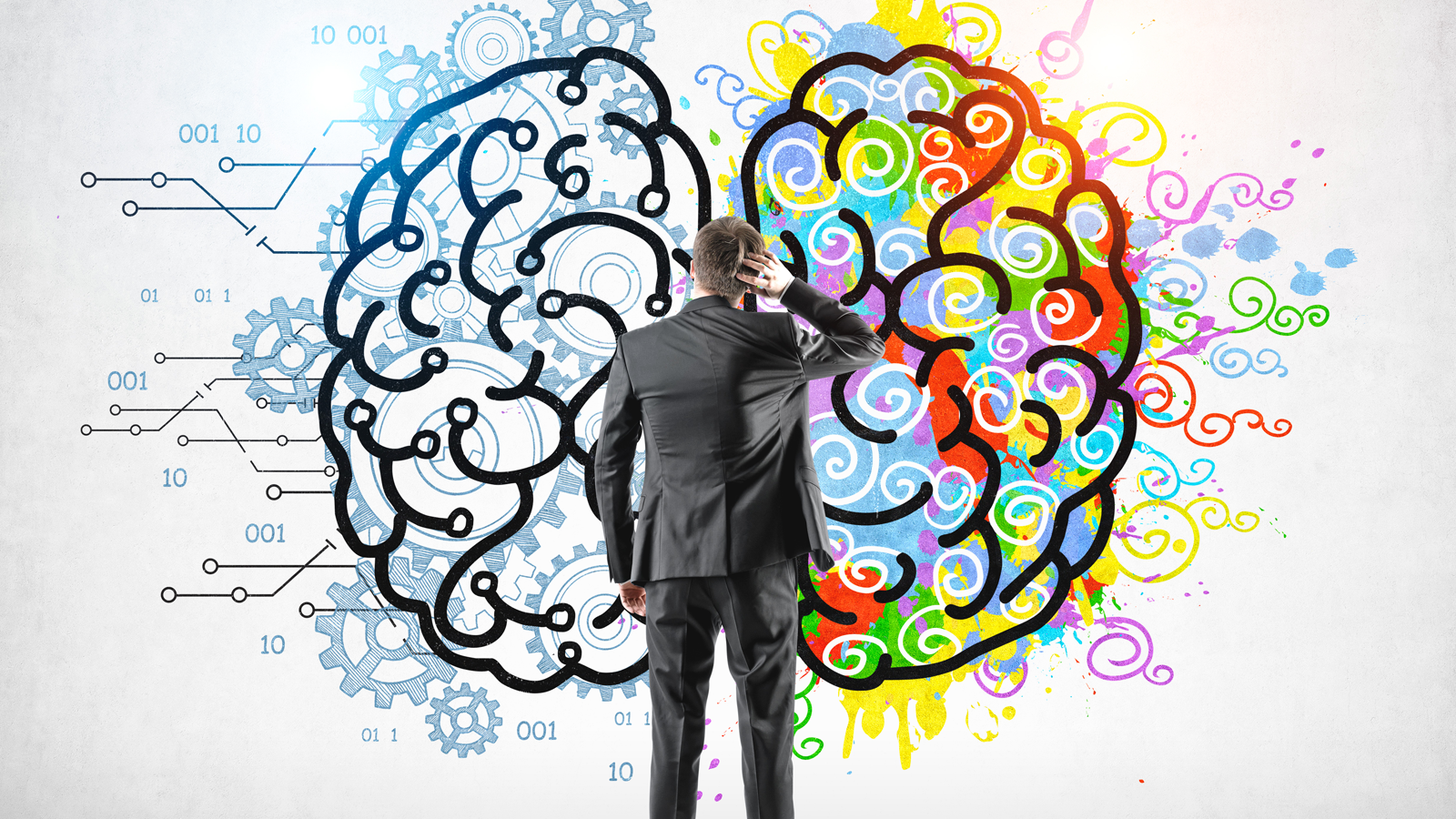
Thinking is associative, slow, and personal — not linear or efficient. It happens sideways, through connections built over time. Facts alone are worthless; understanding is the web between them. Real thinking requires your whole self. Delegating it to AI produces coherent output, but no genuine understanding — and changes no one.

We’ve Stopped Thinking. And We Don’t Even Notice | Part 1/3
AI chat tools let us bypass genuine thinking. Real understanding requires friction, time, and discomfort — not instant answers. By outsourcing cognition, we atrophy our ability to hold complexity, develop perspective, and defend our reasoning. Speed feels like intelligence, but depth is what actually builds a mind.